
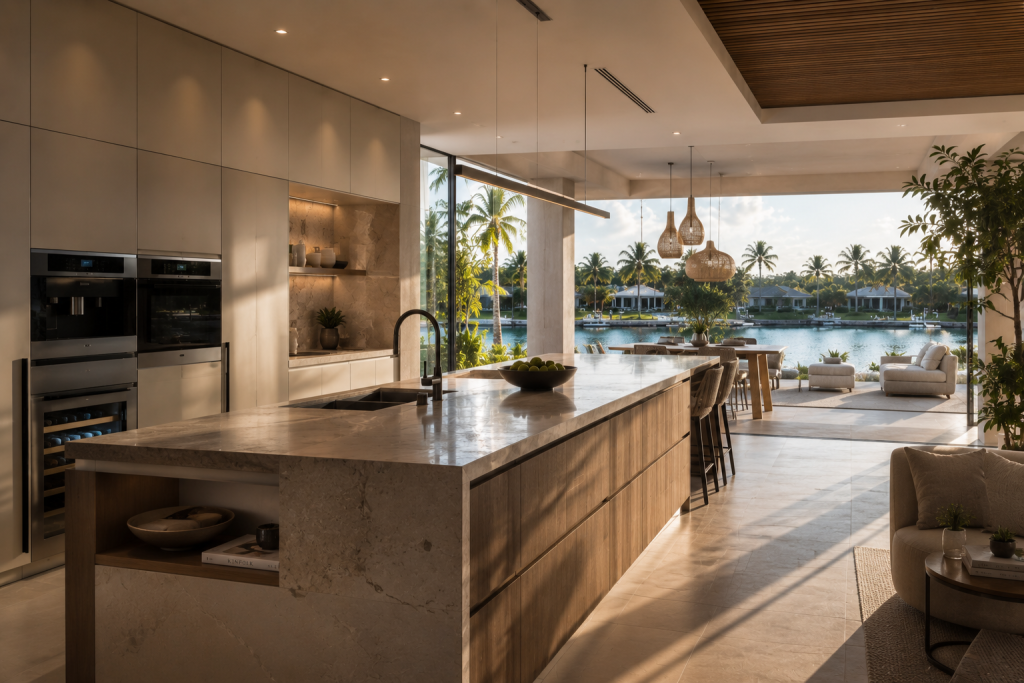
In luxury residential architecture, natural light is often treated as a defining design feature rather than a practical necessity. In the Cayman Islands, where sunlight shapes the atmosphere of a home throughout the day, the relationship between light and interior design becomes even more significant.
Kitchen spaces are increasingly being designed not simply to receive light, but to respond to it. The orientation of the room, the material palette, surface finishes, and spatial layout all influence how light moves through the environment and how the space is ultimately experienced.
In contemporary kitchen design, light becomes part of the architecture itself.
The Kitchen as a Light-Filled Living Space
Modern luxury homes in the Cayman Islands are often designed with expansive glazing, open-plan layouts, and strong connections to outdoor living areas. As a result, kitchens now occupy some of the brightest and most visually prominent spaces within the home.
This changes the role of the kitchen entirely.
Rather than functioning as a separate room, the kitchen becomes integrated into the wider living environment, sharing light, views, and spatial continuity with surrounding areas. Large islands are positioned to maximise interaction with natural light, while cabinetry layouts are designed to preserve openness rather than create visual obstruction.
The effect is a space that feels calm, expansive, and connected to its surroundings.
Material Selection and Light Reflection
Natural light interacts differently with every surface within a kitchen. This is why material selection becomes critical in achieving the desired atmosphere.
High-gloss lacquers can reflect daylight to enhance brightness and depth, while matte finishes absorb light to create a softer, more restrained aesthetic. Glass elements introduce transparency and layering, while natural stone surfaces respond dynamically as light changes throughout the day.
In tropical environments, lighter material palettes are often used to maintain a sense of coolness and visual clarity, particularly in homes with strong sunlight exposure.
The objective is not simply brightness, but balance. Too much reflection can feel clinical, while insufficient contrast can flatten the space visually. The most successful kitchens use materiality to control and refine the quality of light rather than overpower it.
Architectural Alignment and Sightlines
The positioning of the kitchen within the architecture of the home has a direct impact on how natural light is experienced.
Carefully aligned sightlines allow daylight to travel deeper into the property, creating visual continuity between interior and exterior spaces. In waterfront homes, kitchens are often oriented to frame views while maintaining comfortable lighting conditions throughout the day.
Ceiling heights, overhangs, and shading systems also influence how light enters the room. These architectural considerations are essential in the Cayman climate, where controlling heat gain is as important as maximising daylight.
The kitchen therefore becomes part of a larger architectural strategy rather than an isolated design element.
Lighting Beyond Daylight
While natural light shapes the daytime experience, artificial lighting must extend the same atmosphere into the evening.
Integrated lighting systems are increasingly concealed within cabinetry, shelving, and architectural details to preserve the clean visual language of the space. Rather than relying on a single dominant fixture, layered lighting creates depth and flexibility.
Soft under-cabinet illumination can enhance material textures, while subtle ceiling lighting maintains an ambient atmosphere without overwhelming the architecture.
This approach ensures the kitchen transitions naturally from a bright daytime environment to a refined evening setting suitable for entertaining and relaxation.
Creating Calm Through Simplicity
Natural light works most effectively within spaces that feel visually restrained.
Minimalist cabinetry, concealed appliances, and uninterrupted surfaces allow light to move freely across the room without visual interruption. This simplicity creates a sense of calm that aligns closely with contemporary luxury living.
In many high-end Cayman properties, the kitchen is intentionally designed to recede into the wider interior composition. By reducing visual noise, natural light itself becomes one of the defining features of the space.
The result is an environment that feels timeless rather than trend-driven.
Conclusion
Designing kitchens around natural light requires more than selecting large windows or pale finishes. It demands a careful understanding of architecture, materials, orientation, and how people experience space throughout the day.
In luxury homes, these considerations shape not only the appearance of the kitchen, but the atmosphere of the entire living environment.
Working with specialists in bespoke kitchen design in the Cayman Islands ensures that light, materiality, and spatial planning are considered together from the outset, creating kitchens that feel both refined and deeply connected to their surroundings.