
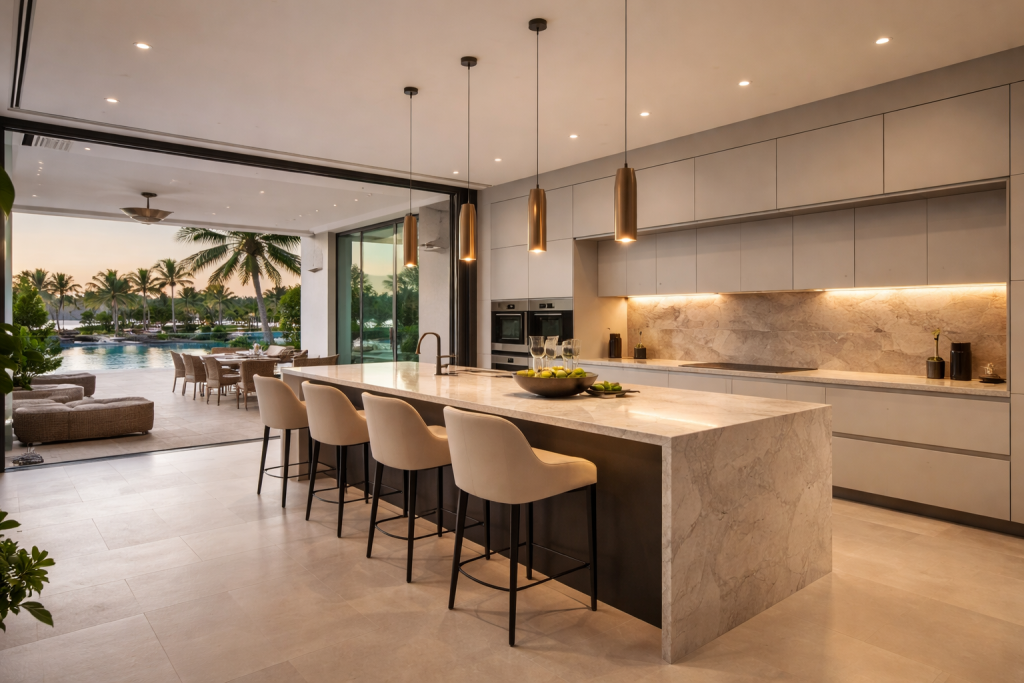
Shaping Space Around Social Living in Luxury Homes
In high-end residential design, the kitchen has evolved into the primary social space within the home. It is no longer defined by its function alone, but by how it supports interaction, movement, and shared experience.
For homeowners in the Cayman Islands, where lifestyle is closely tied to hosting and indoor-outdoor living, the kitchen must operate with a level of flexibility and refinement that goes beyond conventional design. It must accommodate both intimate gatherings and larger occasions, without ever feeling compromised.
This demands a design approach where entertaining is considered from the outset, not added as an afterthought.
Spatial Planning for Flow and Interaction
A well-designed entertaining kitchen begins with spatial flow. Movement through the space should feel intuitive, allowing guests and hosts to coexist without friction.
Central island units often form the focal point, providing a natural gathering place while maintaining clear circulation around the perimeter. This ensures that preparation, cooking, and social interaction can happen simultaneously without overlap.
In larger homes, zoning becomes increasingly important. The kitchen may extend into adjacent dining or lounge areas, creating a layered environment where each zone supports a different aspect of the experience.
The aim is not to separate functions, but to allow them to coexist in a way that feels effortless.
Front-of-House and Back-of-House Thinking
In many luxury kitchens, a distinction is made between what is visible and what is concealed.
The front-of-house area is designed for presentation, clean surfaces, refined materials, and a controlled aesthetic that remains consistent throughout an event. Behind this, a secondary preparation space or utility area can handle the practical demands of cooking, storage, and clean-up.
This approach allows the kitchen to maintain its visual clarity, even during larger gatherings. Guests experience a polished environment, while functionality is preserved behind the scenes.
It is a strategy borrowed from hospitality design, adapted for residential living.
Materials That Perform Under Pressure
Entertaining places different demands on materials. Surfaces must withstand increased use while maintaining their appearance.
Stone worktops, for example, offer both durability and presence, becoming a central feature within the space. Lacquered cabinetry provides a smooth, refined finish that is easy to maintain, while metal and glass elements introduce contrast without adding visual weight.
Material selection is not just about resilience. It is about how surfaces respond to light, touch, and movement throughout the day and into the evening.
In tropical environments, this is further influenced by humidity and temperature, requiring materials that perform consistently without compromising on design.
Lighting as Atmosphere
Lighting plays a pivotal role in shaping how a kitchen feels during social occasions.
Layered lighting schemes allow the space to adapt. Functional task lighting ensures clarity during preparation, while softer ambient lighting creates a more relaxed atmosphere as the evening progresses.
Feature lighting, whether integrated into shelving or positioned above an island, can act as a subtle focal point, adding depth without overwhelming the design.
The goal is flexibility. The kitchen should transition seamlessly from a working environment to a social setting, without the need for visible adjustments.
Indoor-Outdoor Entertaining
In the Cayman Islands, entertaining rarely stays confined to the interior. Kitchens are often designed to extend outward, connecting directly to terraces, pool areas, or outdoor dining spaces.
Large openings, aligned materials, and consistent floor levels create a unified environment where inside and outside feel like a single space.
This continuity allows the kitchen to support a broader lifestyle, one that embraces the climate and encourages movement between spaces.
Outdoor preparation areas or bar extensions can further enhance this, ensuring that the kitchen remains central to the experience, regardless of where guests gather.
Conclusion
Designing kitchens for entertaining requires a shift in perspective. It is not simply about accommodating guests, but about shaping an environment where social interaction feels natural and uninterrupted.
When space, materials, and layout are considered together, the kitchen becomes more than a functional area. It becomes the setting for how people connect, host, and experience their home.
This level of design requires a detailed understanding of both lifestyle and architecture. Working with specialists in luxury kitchen design specialists ensures that these elements are resolved cohesively, creating spaces that perform as beautifully as they look.